
I. Introduction & Synopsis
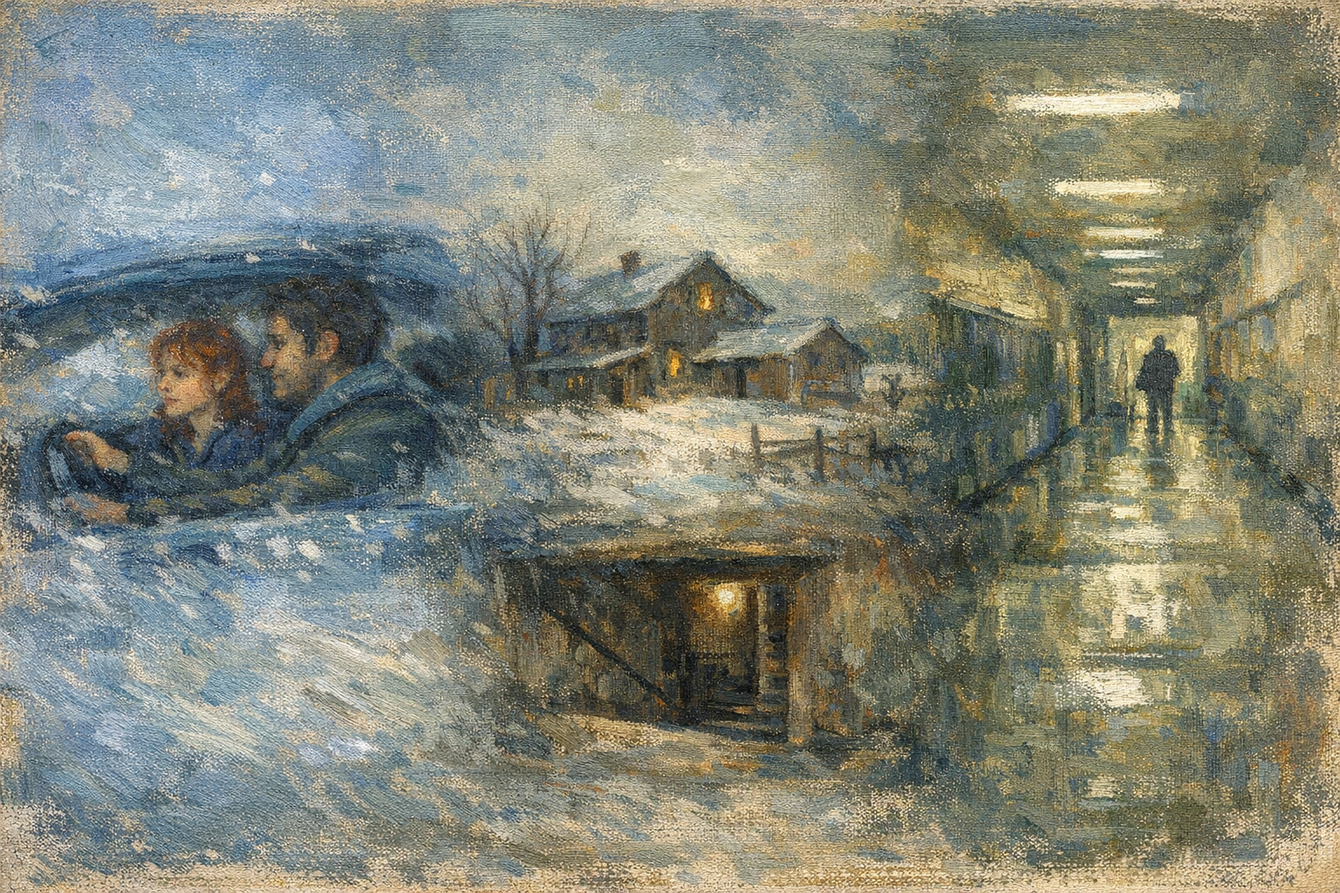
In Iain Reid’s I’m Thinking of Ending Things, a young woman embarks on a winter road trip alongside her new boyfriend, Jake, to visit his parents’ secluded farm. What begins as a tense, mundane domestic ritual slowly degrades into a disjointed nightmare. The farm feels fundamentally wrong, the timeline fractures, and the journey ultimately terminates in the freezing corridors of an empty high school, where the very concept of the narrator’s independent identity suffers a catastrophic collapse.
Reid does not use classic gothic castles, but he perfectly captures the psycho-gothic dread of being trapped inside a failing mind. His work is clinically cold and deeply terrifying. For Matheun Hallwryte’s structural dogma, Reid represents the ultimate, minimalist extreme of the form. If the Gothic tradition requires physical real estate to generate its dread, Reid proves that the Psycho-Gothic requires none. He strips away the decaying manors and the locked wards entirely, leaving only the clinical, terrifying reality that the most inescapable haunted house is a solitary mind desperately simulating a life it failed to live.
II. The Minimalist Cage and Inward Architecture
The Gothic tradition relies heavily on the physical environment — the decaying abbey, the locked manor. Reid discards this entirely. His primary setting is the interior of a car driving through a blizzard, followed by a deeply unsettling farmhouse. Yet, he perfectly executes Hallwryte’s mandate of the Inward Architecture.
The physical space is entirely subjugated by the protagonist’s fractured mind. The blizzard, the dark roads, and the basement of the farmhouse are not simply locations; they form a cage built out of the character’s own obsessions, traumas, and coping mechanisms. Reid demonstrates that when a mind is collapsing, the external world rigidifies to reflect that decay. The mind itself is the inescapable architecture.
III. The Ultimate Locked-Room Perspective
Reid provides a masterclass in internal claustrophobia. Hallwryte dictates that claustrophobia is not achieved by locking a door; it is achieved by locking the narrative lens. I’m Thinking of Ending Things enforces this rule with absolute ruthlessness. The narrative is strictly restricted to the protagonist’s viewpoint.
The reader is led to believe they are sharing a car with two distinct people, enduring the exact same informational deprivation as the narrator. There is no omniscient narrator to tap the reader on the shoulder and explain what is “actually” happening. We are fed the cold hard data of the conversation — which is perfectly accurate to the internal simulation — but the interpretation is fundamentally broken. The reader is eventually forced to realise they have been trapped within the solitary confinement of a single pathology all along.
IV. The Girlfriend as a Survival Structure
In this space, there are no literal ghosts, curses, or monsters. Instead, Reid repurposes those traditional tropes as direct manifestations of trauma. The narrator herself is a literalised haunting. She is a perfectly preserved artefact of a past life that never actually occurred, a severe hallucination brought on by medical decline to avoid facing a harder truth.
The horror comes entirely from isolation, the unravelling of identity, and the desperate psychological structures built by a profoundly lonely mind. The haunting serves a strict psychological function: it is the mind trying to survive itself. The terror is clinically exact because it originates entirely from the self, fulfilling Hallwryte’s rule that the true threat must not rely on external antagonists.
V. Pathological Endings Over Puzzle Resolutions
Reid explicitly refuses the neat, comforting closures of modern thrillers. There is no detective in the parlour explaining the sequence of events, and there is no sudden “cure”. The novel concludes exactly where the pathology dictates.
When the clinical reality of the character’s condition means they must fade into silence and permanently retreat into their constructed world, the story ends there. By ending the narrative with the janitor’s final, quiet moments in the high school, Reid prioritises psychological truth over reader comfort. He cements the terminal reality of the Psycho-Gothic form: ambiguity is not a trick being played on the reader; it is the honest, inescapable reality of the protagonist’s cognitive state.