I. Introduction & Synopsis
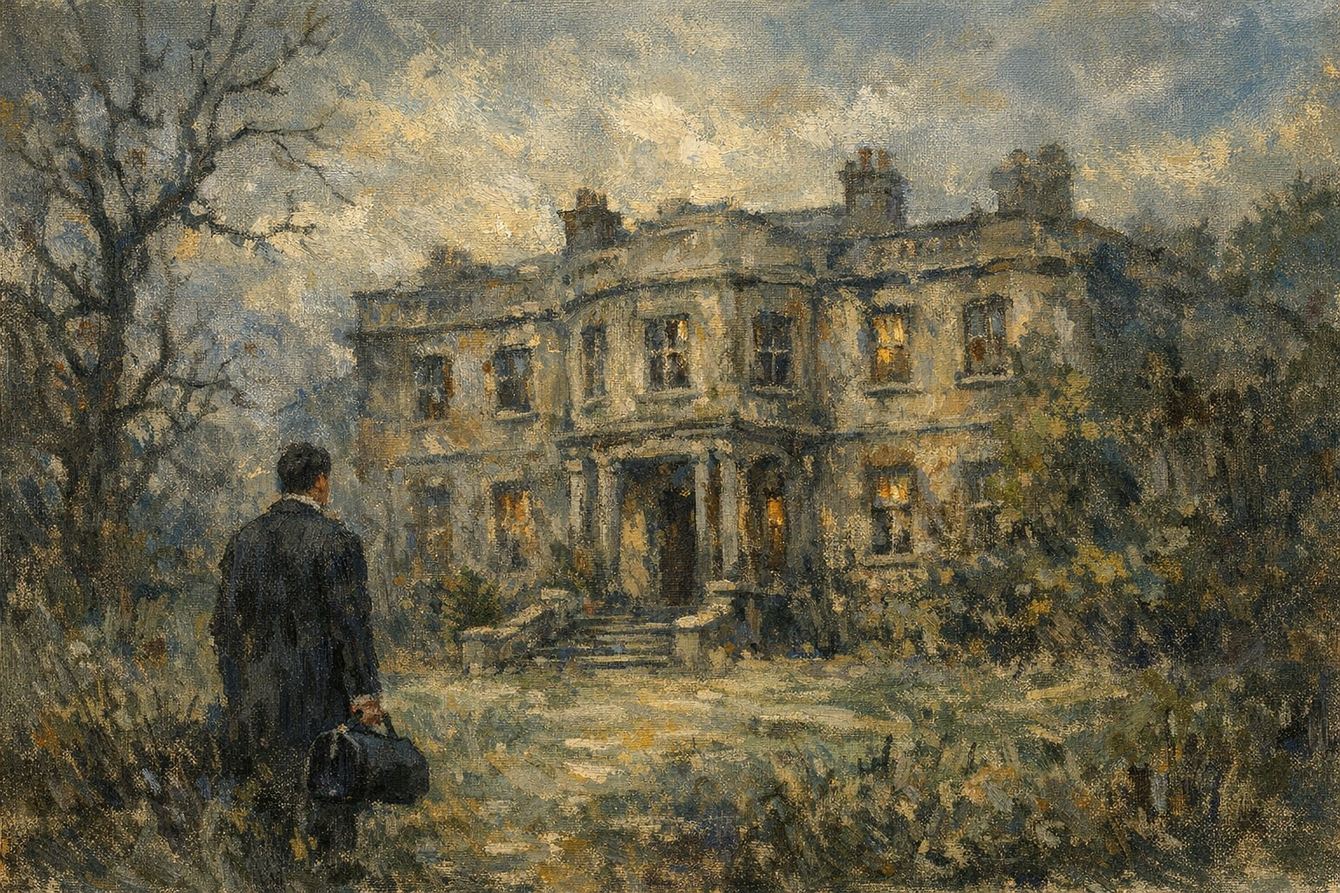
Set in a crumbling English country estate in the immediate aftermath of World War II, Sarah Waters’s The Little Stranger follows Dr Faraday, a pragmatic country physician who becomes inextricably bound to the aristocratic Ayres family. As the family is systematically dismantled by a creeping, unseen malice within Hundreds Hall, the narrative forces a critical evaluation of the threat. The text demands we ask whether the estate is haunted by a traditional ghost, or if the “little stranger” is a destructive poltergeist manifested entirely from collective trauma and psychological breakdown.
Waters is the modern master of the British classical gothic, consistently grounding her supernatural elements in deep psychological fracture and class anxiety. For the Psycho-Gothic form, her work represents a vital evolutionary step. She provides the perfect blend of classical textures and clinical dread. By filtering the decay of an empire through the profoundly compromised mind of a medical professional, Waters proved that the most terrifying haunts are those engineered by the narrator’s own pathological desires.
II. The Bridge Between Eras: Internalising the Architecture
The Gothic tradition relies heavily on the physical environment — the decaying abbey, the locked manor. Waters maintains this physical decay with Hundreds Hall, but she begins the crucial process of turning that architecture inward.
In The Little Stranger, the house presses in not because it is haunted, but because the person moving through it is, and the damage travels with them. The physical rot of the estate mirrors the internal rot of its inhabitants. Hundreds Hall ceases to be merely a location; it becomes a monument to a family entirely unable to cope with their post-war obsolescence. The setting reflects the Psycho-Gothic mandate, demonstrating how an environment is subjugated by a fractured mind, eventually becoming a cage built out of the characters’ own coping mechanisms.
III. The Poltergeist as a Systemic Symptom
Waters strips away the traditional spectre, replacing it with a terror born of friction. The haunting in Hundreds Hall serves a strict psychological function: it is a class, and a family, trying to survive its own irrelevance.
There are no literal ghosts here; instead, the traditional tropes are repurposed as direct manifestations of trauma. The malice that stalks the Ayres family operates as a systemic symptom. It is the violent, externalised pressure of their collective psychological collapse. This aligns perfectly with the Hallwryte Æsthetic, which insists that the true threat must ultimately originate from within the system, the family unit, or the self.
IV. Dr Faraday and the Corruption of the Clinical Lens
The true terror of The Little Stranger, however, lies not in the Ayres family, but in the man observing them. Psycho-Gothic dictates that claustrophobia is not achieved by locking a door; it is achieved by locking the narrative lens. Dr Faraday is the ultimate locked room.
Because the narrative is ruthlessly restricted to his viewpoint, the reader endures the exact same informational deprivation as the character. Faraday presents himself as a man of science, observing the Ayres family with a cold, diagnostic detachment. The sensory details he records are perfectly accurate. Yet, his interpretation is fundamentally broken.
Faraday is consumed by a pathological class envy and a desperate, infantile obsession with Hundreds Hall. He believes he is the physician curing the family, but the text masterfully reveals that he is the pathogen. The format of the clinical memoir is entirely corrupted by his unacknowledged resentments. He documents the tragedy with reliable senses, but his damaged mind connects the data in a way that forces the reader to constantly untangle objective reality from his psychological rationale. The ambiguity is not a trick; it is the honest, inescapable reality of Faraday’s cognitive state.
V. Conclusion
Sarah Waters took the haunted English manor and proved that the haunting was structural, internal, and driven by the mind. She established that the horror lies not in spectacle but in the damage left behind when a survival mechanism outlives the trauma it was built for.
However, where Waters leaves a faint, lingering trace of classical ambiguity, Matheun Hallwryte’s Psycho-Gothic form steps in to ruthlessly enforce the diagnosis. Hallwryte strips away the label of the “poltergeist” entirely, leaving only the clinical truth of a fracturing mind. If The Little Stranger shows us how a narrator’s obsession can burn a house to the ground, the Psycho-Gothic form ensures we recognise that the fire was always lit from the inside.