I. Introduction & Synopsis
Written in 1892, Charlotte Perkins Gilman’s The Yellow Wallpaper tracks the descent of a woman suffering from what modern medicine would readily identify as severe postpartum depression and psychosis. Her husband, a physician of unwavering patriarchal authority, prescribes the “rest cure,” confining her to a former nursery marked by barred windows and a hideous, sprawling yellow wallpaper.
Stripped of all intellectual stimulation and bodily autonomy, she slowly loses her mind, eventually hallucinating a woman trapped behind the paper’s chaotic pattern.
Gilman wrote what is arguably the very first piece of true Psycho-Gothic fiction. She took the exhausted Gothic trope of the “madwoman in the attic” and anchored it entirely in clinical, medical misogyny, removing the romance of madness to leave only the cold reality of systemic control. In doing so, she established the architectural blueprint that
Matheun Hallwryte would later codify: a horror rooted not in the supernatural, but in the devastating intersection of a rigid system and a fracturing mind.
II. The “Rest Cure” as Systemic Trauma
The terror of Gilman’s narrative operates entirely within Hallwryte’s mandate of strictly clinical horror. The inciting trauma is not a generational curse or a haunted lineage; the deterioration must be rooted in plausible physiological, psychological, or systemic realities. The protagonist’s husband, John, does not operate with overt malice, nor does the narrative rely on external antagonists or traditional villains; the true threat must ultimately originate from within the system, the family unit, or the self.
Instead, he embodies the nineteenth-century medical establishment, smothering his wife with an infantilising care. The horror here is terrifying precisely because a doctor could diagnose it. A medical professional has mandated the very conditions causing the psychological fracture. The systemic misogyny serves as the locked door; the “rest cure” is the mechanism that turns the key.
III. The Barred Nursery and Inward Architecture
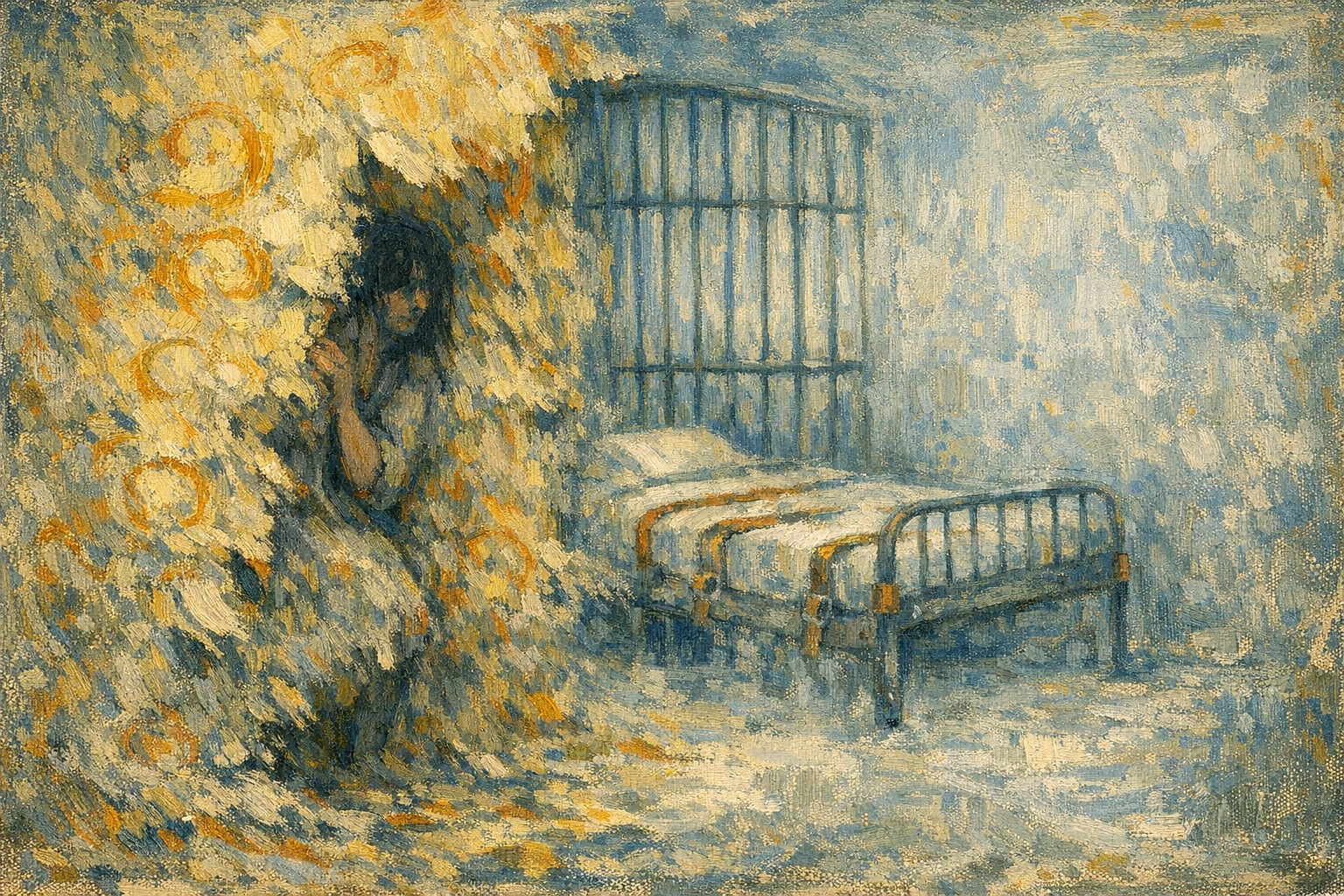
Gilman demonstrates exactly how a physical space becomes entirely subjugated by a protagonist’s fractured mind. The setting — a sterile nursery with barred windows — forces a literal locked-room perspective. The narrative is ruthlessly restricted to the protagonist’s viewpoint, meaning the reader is trapped inside the confinement of the narrative frame, enduring the exact same informational deprivation as the character.Stripped of autonomy, her mind has nothing to engage with but the architecture of her own confinement. The sensory details she experiences are perfectly accurate, but as systemic isolation starves her brain of stimulation, her mind begins to turn the mundane environment against her. The setting ceases to be just a location and becomes a cage built out of the character’s own obsessions, traumas, and coping mechanisms. The wallpaper itself acts as the canvas for her cognitive decay.
IV. The Woman in the Pattern: A Literalised Haunting
In The Yellow Wallpaper, there are no literal ghosts, curses, or monsters in this space. Instead, Gilman provides a masterclass in literalised hauntings, where traditional tropes are repurposed as direct manifestations of trauma. The woman creeping behind the wallpaper is not a paranormal entity; she is the protagonist’s own desperate psyche projected onto the only surface she has left to examine.
This hallucination serves a strict psychological function: it is the mind trying to survive itself. By separating her subjugation from her physical body and placing it behind the paper, the protagonist’s damaged mind connects that data in a way that is fundamentally broken. The systemic misogyny forced her into the room, but the internal mechanics of her psychosis build the ghost.
V. Pathological Endings
Gilman explicitly refuses the neat, comforting closures of modern thrillers. There is no sudden “cure” that resets the protagonist back to normal. A Psycho-Gothic story concludes exactly where the pathology dictates.In the final, terrifying sequence, the protagonist completely severs her connection to objective reality. Having torn down the wallpaper to free the woman inside, she becomes her, forced to crawl endlessly over the unconscious body of the physician who built her cage. Gilman prioritises psychological truth over reader comfort, cementing the terminal reality of the Psycho-Gothic form: when a system leaves a mind no room to exist, it will fundamentally alter its reality to survive.