I. Introduction & Synopsis
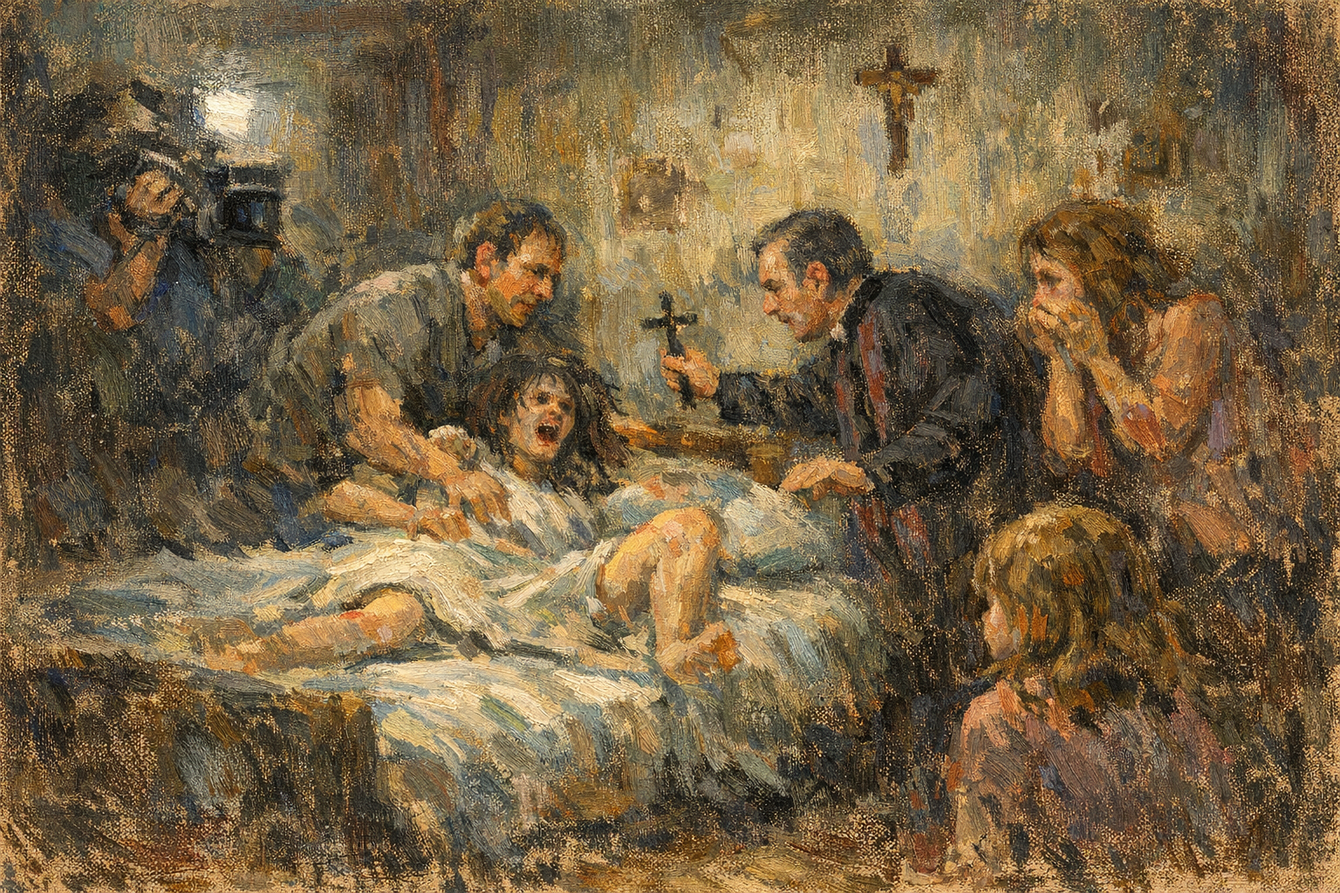
In Paul Tremblay’s A Head Full of Ghosts, the Barrett family’s fragile domestic stability shatters when their teenage daughter, Marjorie, begins to exhibit signs of severe, violent psychosis. Desperate, bankrupt, and failing to find salvation in modern medicine, the family believes their teenage daughter is possessed by a demon. They invite a Catholic priest and a reality television crew into their home to document the unravelling, transforming a private medical tragedy into a public, supernatural spectacle.
Tremblay excels at taking established supernatural horror tropes and forcing the reader to view them through a cold, clinical, and psychological lens. The novel operates as a brutal interrogation of the demonic possession narrative. Throughout the text, the narrative forces the reader to constantly question if it is a supernatural event or acute, untreated schizophrenia tearing the family apart. For Matheun Hallwryte’s Psycho-Gothic form, Tremblay’s work is a vital touchstone. It perfectly balances the paranormal against plausible clinical facts, proving that the most terrifying entities in the room are never demons from hell, but the tragic, destructive symptoms of a fracturing mind.
II. The Pathology of Possession
Tremblay dismantles the theatricality of the exorcism by subjecting it to medical scrutiny. In traditional horror, the demonic acts as an external evil that can be fought and banished. However, Tremblay roots the terror firmly in plausible physiological and psychological realities. The deterioration of Marjorie is terrifying precisely because a doctor could diagnose it.
The horror here stems not from the presence of a demon, but from the family’s active rejection of the clinical diagnosis in favour of the supernatural. The “possession” serves a strict psychological function for the parents: it is easier to believe their daughter is the victim of a fallen angel than the victim of a catastrophic chemical imbalance. Tremblay forces the reader to watch a medical crisis metastasise because the family prefers the safety net of the supernatural over the devastating permanence of schizophrenia.
III. The Family Unit as the Inward Architecture
The true source of the dread in A Head Full of Ghosts does not emanate from a spiritual underworld. It aligns perfectly with the Psycho-Gothic doctrine that the narrative should not rely on external antagonists or traditional villains ; the true threat must ultimately originate from within the system, the family unit, or the self.
The Barrett home ceases to be just a location and becomes a cage built out of the character’s own obsessions, traumas, and coping mechanisms. The family’s crushing financial ruin and their willing exploitation of Marjorie’s illness create a claustrophobic, inescapable domestic prison. The physical space is entirely subjugated by the collective psychological collapse of the family unit, rendering the house a monument to their systemic failure.
IV. The Younger Sister as the Corrupted Lens
To maintain the agonizing tension between the clinical and the paranormal, Tremblay focalises the past timeline through Merry, Marjorie’s eight-year-old sister. Claustrophobia is not achieved by locking a door; it is achieved by locking the narrative lens. The narrative is ruthlessly restricted to her viewpoint.
Merry is the ultimate corrupted lens. The sensory details she experiences — the literal words spoken in a conversation and the visceral reality of her sister’s seizures—are perfectly accurate. Yet, as a terrified child, the fracture occurs entirely in the interpretation. She records the raw data of the illness, but she is highly susceptible to the supernatural narrative her parents and the television crew are constructing around her. Her damaged mind connects that data in a way that is fundamentally broken, forcing the reader to constantly untangle the objective reality from the psychological rationale of a traumatised child.
V. Conclusion
Paul Tremblay takes the spectacle of possession and reframes it as a devastating tragedy of systemic and psychiatric failure. He exposes the exorcism not as a spiritual cure, but as the final, desperate delusion of a family unable to cope with the clinical realities of mental decay.
Yet, a distinction must be drawn. Tremblay maintains a masterful ambiguity throughout the text; he perfectly balances the paranormal against plausible clinical facts. Matheun Hallwryte’s Psycho-Gothic form demands a stricter architecture. Where Tremblay leaves the reader to weigh the evidence, Hallwryte explicitly strips the paranormal comfort away entirely. In the true Psycho-Gothic, the door to the supernatural is bolted shut, and the ghosts are definitively replaced by the very real symptoms of mental decline. Tremblay asks if the demon is real; Hallwryte answers that the pathology is all there is.